
Architecture
Overview
Where things live, how they interact and the "three-layer system"
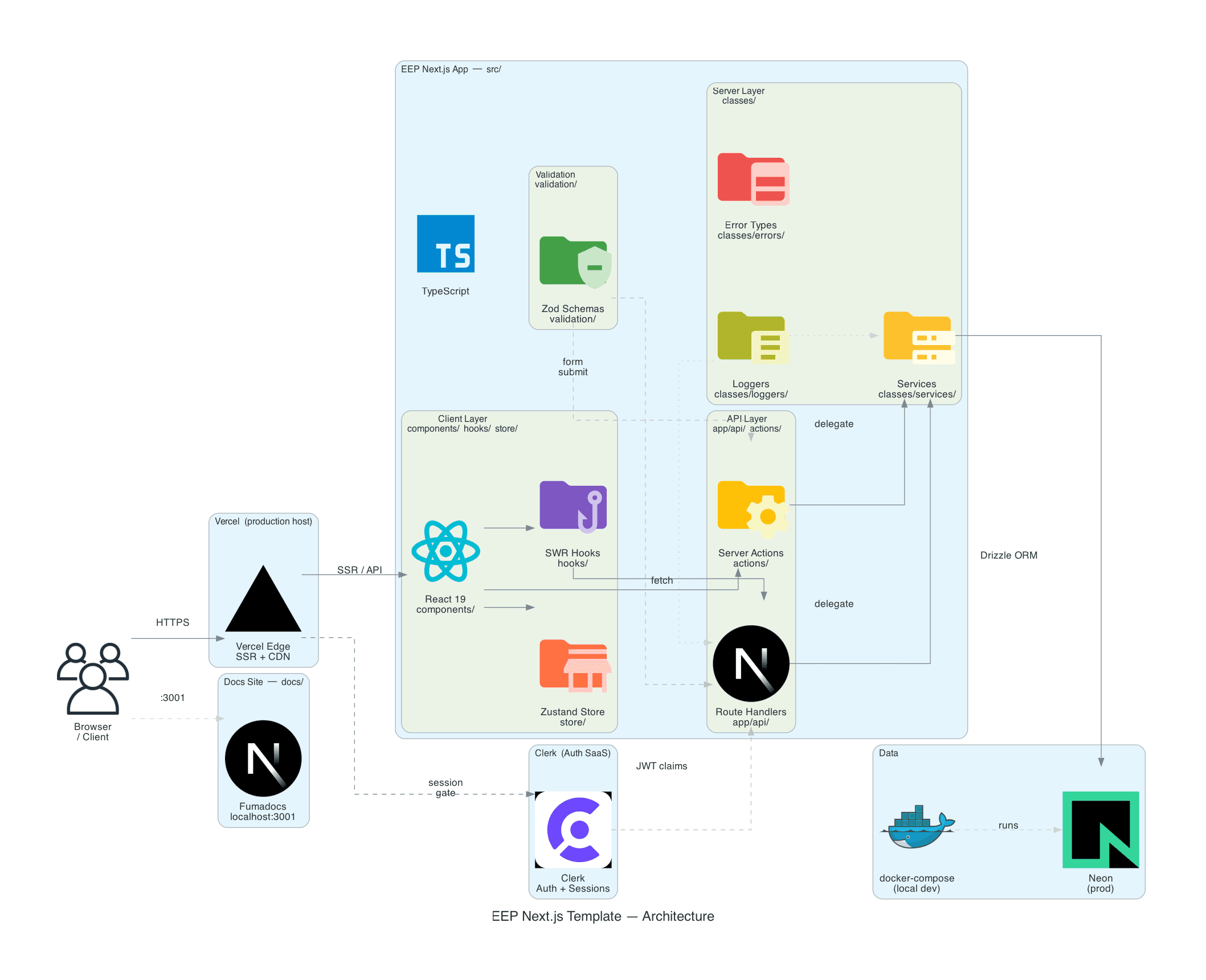
Where things live
src/ - application code
Tests live in a __tests__/ subfolder co-located with the code they test -
this applies across components/, hooks/, store/, utils/, and
validation/. See Testing for the full
convention.
| Location | What lives here | Rule |
|---|---|---|
app/ | Next.js file-convention files only | page.tsx, layout.tsx, error.tsx, not-found.tsx etc. - thin shells that delegate to components/ and classes/. No business logic. |
app/(app)/ | Authenticated app pages | All pages that require a signed-in user. Layout mounts the auth gate and navbar automatically. |
app/(auth)/ | Auth pages | Sign-in and sign-up. Bare layout - no navbar, no auth gate. |
app/restricted/ | Role-based access denial | Shown when a signed-in user lacks a qualifying role (Admin or SuperAdmin). Lives outside (app)/ so it can be reached without passing the role check again. |
app/api/ | Route handlers | Reads + external writes; auth enforced in-handler (withAuth/withRole); Zod-validated at the boundary |
actions/ | Server actions | UI writes; share the same Zod schema and role gate as the route |
components/ui/ | shadcn primitives | Owned by you - edit freely to match your design system |
components/common/ | Shared UI components | Reusable across features; never import from classes/ |
components/features/ | Feature-specific components | Scoped to one feature; never import from classes/ |
components/providers/ | Client-side React context providers | Wrappers that make a service available to the whole component tree via React context (e.g. SWR config, theme). Composed here, mounted once in layout-client.tsx |
hooks/ | SWR data-fetching hooks | One file per resource (use-*.ts); no useEffect fetching |
store/ | Zustand stores | One file per domain; co-locate types |
classes/services/<domain>/ | Business logic + integrations | server-only; one folder per domain |
classes/errors/ | Shared error types | Not server-only - thrown from both layers |
classes/loggers/ | Logger classes | server-only - Winston writes to the filesystem (Node.js only) |
validation/ | Zod schemas | One file per domain; shared between route and action |
types/ | Shared TypeScript types | Pull up only when consumed across unrelated layers |
lib/ | Third-party instantiation | Config and init only - no business logic |
config/constants/ | App-wide constants | Only for values shared across multiple modules |
utils/ | Shared utility functions | Pure functions |
db/ | Drizzle schema, pool, migrations | Schema is the source of truth; types inferred from it |
proxy.ts | Next.js middleware (Clerk auth gate) | Lightweight checks only - redirects and session reads |
Project root - tooling and infrastructure
| Location | What lives here |
|---|---|
scripts/ | DB seeding, smoke checks, asset copy scripts. Run outside the Next.js context via tsx. |
e2e-tests/ | Playwright end-to-end tests. One spec per feature. |
contract-tests/ | Live network checks that a third-party API still returns the shape we depend on. Run with pnpm test:contract. |
drizzle/ | Generated SQL migrations and Drizzle metadata. Committed - never edit by hand. |
docs/ | This documentation site (Fumadocs). Separate Next.js app, runs on :3001. |
diagrams/ | Architecture diagram source (main.py). Regenerate with cd diagrams && uv run python main.py. |
eslint-rules/ | Custom ESLint rules specific to this project. |
public/ | Static assets served at /. Includes vendored Swagger UI bundle. |
.github/ | GitHub Actions CI workflow (workflows/ci.yml) and the pull request template. |
.devcontainer/ | Dev Container config for a zero-setup VS Code / Codespaces environment. |
.husky/ | Git hooks. The pre-commit hook runs lint, typecheck, tests, and build. |
The three layers
The template is built on three strict layers, which foster clear separation of concerns and code reusability! Each layer has one job and one place to house the code. Business logic never bleeds into route handlers, data access never appears in components.
Client - components/, hooks/, store/
Everything the browser runs.
- All data fetching goes through SWR hooks in
hooks/ - All client state goes through Zustand stores in
store/ - Components are purely presentational, they receive data and call handlers
Server - classes/
All business logic lives here, and only here.
- Services in
classes/services/<domain>/areserver-only, they can never be imported by client code - Services own all data-access logic (Drizzle queries, third-party API calls)
- Services expose a small typed surface to the API layer
API - app/api/, actions/
The boundary between the browser and the server.
- Route handlers own reads and external writes
- Route handlers and actions call service methods, they never query the database directly
- Server actions own UI writes (POST/mutations from our own UI). See Read vs Write for the full breakdown of why.
- Both surfaces validate all input with Zod schemas before anything reaches the service layer